Do you ever wonder how to change the text case after you have typed? By default Office applications like Word uses the sentence case for writing with first letter as capital. However, you can easily change the text case in all Office applications. In this article, we will explain how to do that using in-built option as well as with other tools.
Default Text Case Usage
Word, PowerPoint and Outlook apps will use the backstage AutoFormat and AutoCorrect settings to correct the text cases.
- For example, launch Word and go to “File > Options” menu.
- Click on the “AutoCorrect Options…” button under the “Proofing” section.
- You can change the options under AutoFormat, AutoCorrect and AutoFormat As You Type tabs.
Some of the useful options are to capitalize the first letter of the sentence and correct accidental usage of capital letters.

Manually Changing Text Cases
The auto correct and auto formatting will not help to convert already written sentences to different cases. Let us say, someone sent you an email with Word attachment containing content with all capital letters. If you are embarrassed to read with capital cases, you can simply convert the content into readable sentences case with few clicks.
Change Text Case in Word
Word has many options for changing text cases compared to other Office applications.
- Open your document and select the text you want to convert the case.
- Under the “Home” tab, click on the “Change Case” icon showing as Aa.
- It will show the dropdown and allow you to change cases in different manner.

Explanation of Different Text Cases
- Sentence case – this will change the first letter of all sentences to capital and leave other cases in small. This is a default case used in general for writing text content.
- Lowercase – convert all letters to small case letters.
- Uppercase – convert all letters to upper case letters.
- Capitalize each word – only capitalizes the first letter in each word of the selected text.
- Half-width – convert the text width to half, generally not applicable for many of the standard fonts.
- Full-width – convert the text into a full-width font style by justifying the content to full-width.
Related: How to create eBook from Word document?
Typing with Small Caps and All Caps
In addition to the above text cases, you can also type the text in small caps or all caps (all uppercase) from the font settings dialog.
- Select the text and press “Control + D”. Alternatively, you can click on the small arrow in the “Font” group under “Home” tab.
- This will open Font dialog where you can check “Small caps” option and click ‘OK”.
- Now, you can type with small caps.
- Similarly, you can check “All caps” to start typing in capital letters. However, you can simply do this by turning on the Caps Lock key on your keyboard.
There are few problems in using this method:
- You manually need to disable the check boxes again to go back to normal typing mode.
- You cannot convert small caps text into any other format.
Example with Different Text Cases
Below is an example of different text cases in Word:
| Sample Sentence | Type |
| This is a sentence with sentence case. | Sentence case |
| this is a sentence with all lowercase. | Lowercase |
| THIS IS A SENTENCE WITH ALL UPPERCASE. | Uppercase |
| This Sentence Is Capitalized With Each Word. | Capitalize each word |
| tHIS IS an EXAmPLE OF UsING TOgGLE CAsE SENTENCE. | Toggle case |
| This is a half-width sentence. | Half-width |
| This is a full-width sentence. | Full-width |
| HERE IS AN ALL SMALL CAPS SENTENCE. | Small caps |
| HERE IS AN ALL CAPS SENTENCE. | All caps |
Keyboard shortcut: You can select the text and press “Shift + F3” to toggle the text case between upper, lower and capitalize each word options.
Change Text Case in Outlook
In outlook, you cannot change the case when reading the emails as it will be in a read mode. However, you can change the text case in following ways:
- When creating a new email or calendar entry.
- By replying to the email and change the case.
Go to “Format Text” menu and click on the “Change Case” icon. You will have similar options like Word to change the text.

If you the option is greyed out then click on the HTML or Rich Text option in the beside “Format” group.
Change Text Case in PowerPoint
PowerPoint also has similar option like Word. When you are in the textbox, go to “Home” menu and click on the “Change Case” icon to select the option from the dropdown. However, we do not see half and full-width options in PowerPoint.

Change Text Case in Excel
Excel is completely a different application, as it is not meant for word processing. However, you can use predefined functions to change the text case.
- Proper(text) – converts the text by capitalizing each word.
- Upper(text) – converts the text into uppercase.
- Lower(text) – converts the text into lowercase.
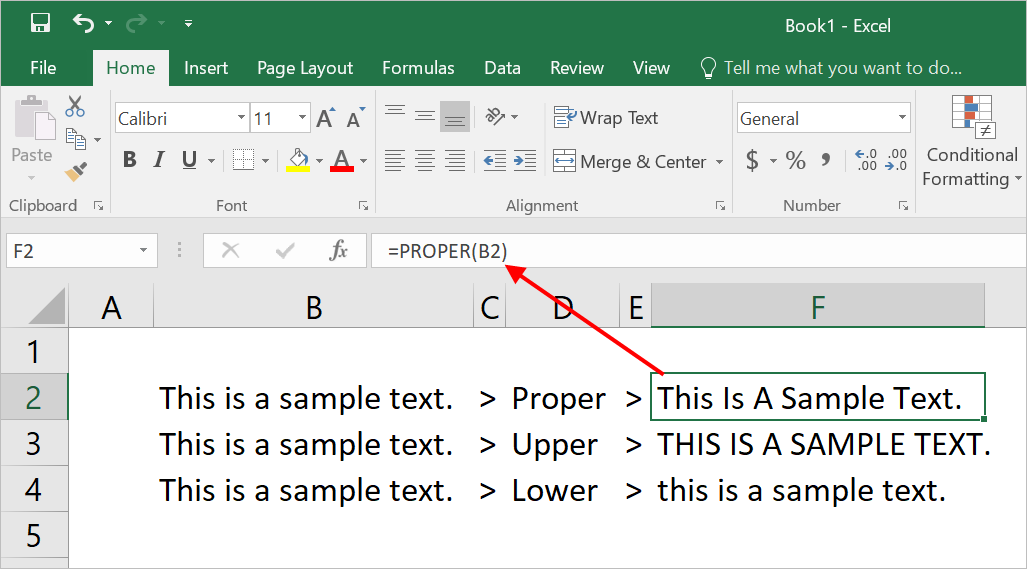
You should refer the original cell value in one of the above functions to convert them accordingly. For example, below is the screenshot from Excel converting the cell values B2, B3 and B4 to proper, upper and lower case respectively.
Text case changing also works on Office 365 in Mac as explained above.
Different Language Other than English
Now that you may have one question – what happens when using different language other than English? As far as we have checked, nothing happens, as most of the languages do not have upper and lower cases separately.
Text Case Changer Tool
If you have lot of text content to change the case online then try our free text case changer tool. Simply, copy paste the text and select the option to convert.
The above tool also helps you to count the number of words and characters in a document. It will dynamically count and show the result when you enter text in the input box.