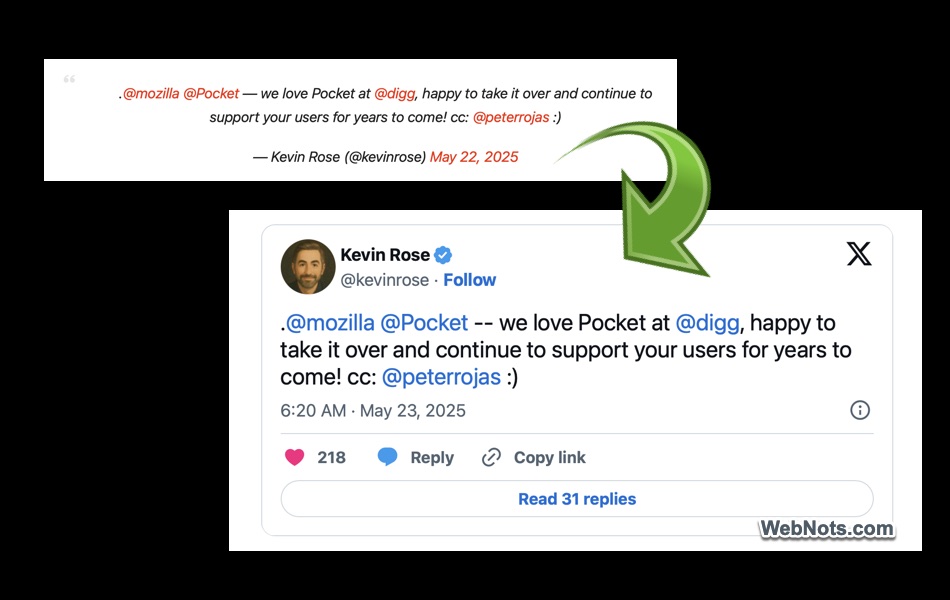
Anthropic’s much anticipated stock market debut delivered a spectacular opening, but the excitement faded almost as quickly as it arrived. The episode offered a timely reminder that investor enthusiasm and business fundamentals do not always move in the same direction. More importantly, Anthropic is no longer the most instructive example of the risks surrounding the artificial intelligence boom. The bigger lessons are emerging from companies once considered virtually untouchable, including Nvidia and Google in a larger scale, and Reddit in a smaller scale.
Anthropic’s Quickly Faded Fortune
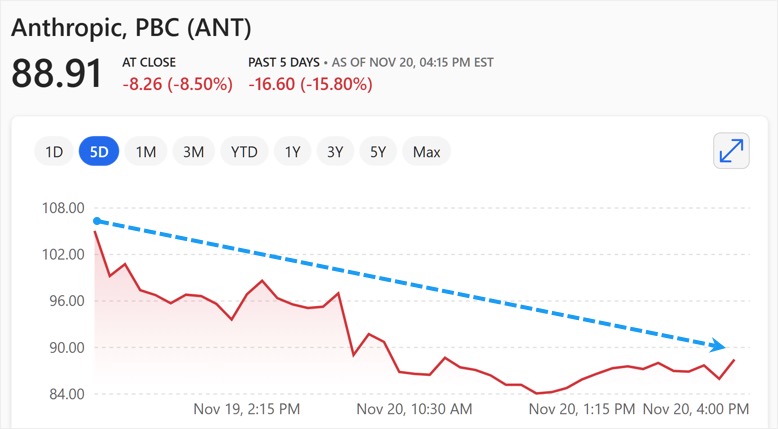
Anthropic’s November 19, 2026, debut briefly pushed its valuation close to $2 trillion. Shares opened 34% above the offering price before retreating toward $89 within two trading sessions. The dramatic reversal illustrated how scarcity, market narratives, and retail enthusiasm can fuel an initial surge, only for valuation concerns to bring prices back down.
Established technology companies are also facing questions about whether their growth can justify increasingly ambitious expectations. Even the companies supplying the infrastructure, controlling major platforms, and developing leading AI models are discovering that technological leadership does not guarantee unlimited financial returns.
Nvidia: When the AI Infrastructure Boom Meets Reality
Nvidia entered 2026 as the world’s most valuable company and the undisputed driving force behind the global AI infrastructure expansion. Its graphics processing units (GPUs) had become essential components of the data centers powering generative AI. Yet by mid-November, Nvidia had reportedly lost nearly $2 trillion in market capitalization from its October 6 record, representing a decline of more than 30% in less than six weeks. Its forward price-to-earnings ratio had fallen to approximately 11.3, its lowest level since 2011 and well below its historical valuation range.

Several developments contributed to the decline. On November 12, CEO Jensen Huang resigned after 33 years, with the company’s board confirming that he would not return to the position (although they reverted the decision on November 23, to reinstate his as a CEO). His departure removed a significant element of investor confidence built around his leadership, strategic vision, and ability to coordinate Nvidia’s extensive AI ecosystem. Corporate governance concerns also attracted attention, particularly regarding Nvidia’s financial relationships with its customers. The company reportedly held approximately $99 billion in customer related investments, including a substantial stake in OpenAI. It had also guaranteed up to $105 billion in lease payments associated with an OpenAI data center.
These arrangements raised questions about circular financing within the AI industry, where technology suppliers provide financial support to companies that subsequently spend money purchasing their products. Such relationships can accelerate infrastructure investment, but they also complicate the assessment of underlying demand and financial sustainability.
Nvidia’s third quarter fiscal 2027 results were impressive. Revenue more than doubled to $115.8 billion, while data center revenue increased 110% to $107.6 billion. The company also raised its fiscal 2028 growth forecast. Despite these strong numbers, the stock continued to decline. The reason was a shift in investor attention from current earnings to the sustainability of future growth. The message is clear that even a company at the center of the AI revolution may not be attractive at every valuation.
Reddit: The Hidden Risk of Depending on Search Traffic
Reddit provides a different lesson from Nvidia. Its experience highlights the vulnerability of businesses that depend heavily on distribution channels controlled by other technology companies. For years, Google Search helped Reddit attract users looking for answers, discussions, product recommendations, and real-world experiences. However, the introduction of AI powered search features (such as AI Mode and AI Overviews) has changed how people discover information online.
Reddit’s October 2026 earnings demonstrated the disconnect between strong financial performance and investor expectations. Revenue increased 53% to $895 million, comfortably exceeding estimates. Free cash flow reached $363 million, representing a healthy 41% margin. By conventional financial measures, the quarter was impressive. Nevertheless, Reddit shares fell 29% in a single trading session and remained significantly below their September 2025 peak.
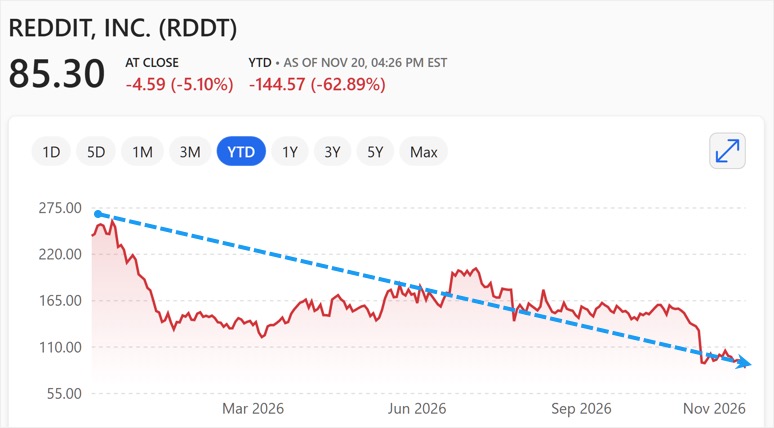
The primary concern was the impact of Google’s AI Mode and AI Overviews on referral traffic. Instead of directing users to external websites, Google’s AI powered search features increasingly provide answers directly within search results. This reduces the need for users to click through to websites such as Reddit. The consequences were already becoming visible. Search referral traffic declined by more than one million visits per week in October, while management warned that daily active users could experience a low double digit percentage decline in the fourth quarter.
The broader implication extends beyond Reddit. Publishers, online communities, affiliate websites, and other businesses that depend on organic search traffic face a similar challenge. Even if their content remains valuable, changes in search technology can reduce their visibility, traffic, and monetization opportunities. Being part of the AI ecosystem does not necessarily mean benefiting from it. Businesses that depend on platforms they do not control remain exposed to changes in those platforms’ commercial priorities.
Google: The Problem of Disrupting Your Own Business
Google faces an even more complicated challenge because it is both developing AI technology and operating the search business that AI threatens to transform. For more than two decades, Google’s advertising business has relied on a relatively straightforward model: users search for information, click on relevant links, and generate advertising revenue along the way.
Generative AI changes this interaction. AI powered search can answer questions directly, summarize information, and reduce the number of external links users need to visit. While this may improve the search experience, it also creates questions about how Google will preserve its advertising economics. Alphabet’s third quarter 2026 earnings reportedly highlighted this tension. AI Mode queries generated less advertising revenue per search than traditional search activity.
Search advertising revenue increased 12% to $63.3 billion, slowing from the stronger growth recorded earlier in the year and missing market expectations. The market reaction was severe. Alphabet shares reportedly plunged as much as 13%, wiping out more than $500 billion in market capitalization. The irony is difficult to ignore. Search query volume reached a five year high, but more searches did not necessarily translate into proportionately higher advertising revenue.
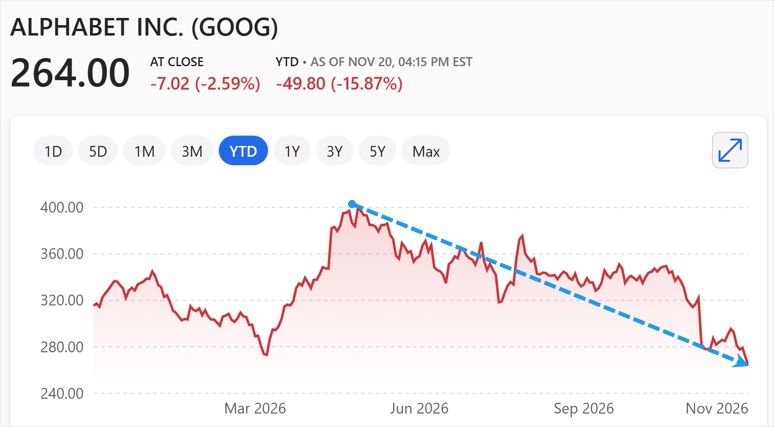
At the same time, Google must spend enormous amounts of money to remain competitive in AI infrastructure. Capital expenditure reached $51.3 billion during the quarter, while free cash flow turned negative at $9.1 billion. Its future commitments for data centers and energy infrastructure also represent a substantial financial burden.
Google therefore faces two simultaneous challenges: protecting the profitability of its existing search business while funding the infrastructure required to compete in the next generation of AI. If a company with Google’s financial resources, technological expertise, and global distribution cannot completely avoid the economic consequences of this transition, investors should be cautious about assuming that every AI related business deserves a premium valuation.
The Common Lesson: AI Growth Does Not Guarantee Investor Returns
Anthropic, Nvidia, Reddit, and Google represent four different dimensions of the AI investment story. Their experiences point toward a common conclusion that investors are beginning to distinguish between the promise of artificial intelligence and the financial returns businesses can realistically generate from it. AI adoption will continue, infrastructure requirements will evolve, and businesses will find new ways to integrate intelligent systems into their operations to bring the stock prices back. However, the assumption that every company associated with AI will become a major financial winner is increasingly difficult to justify.