Recently, we received a surprising email from a company called Copytrack. It demanded payment for the use of an image copyrighted to their client, YayImages. If you receive such an email, here is how to handle it without panicking.
Emails from Copytrack
Initially, we ignored their emails, which were sent to multiple email addresses across our domain. However, they continued to send the same messages with new payment deadlines. Below is an example of their email, asking for payment in 10 days.
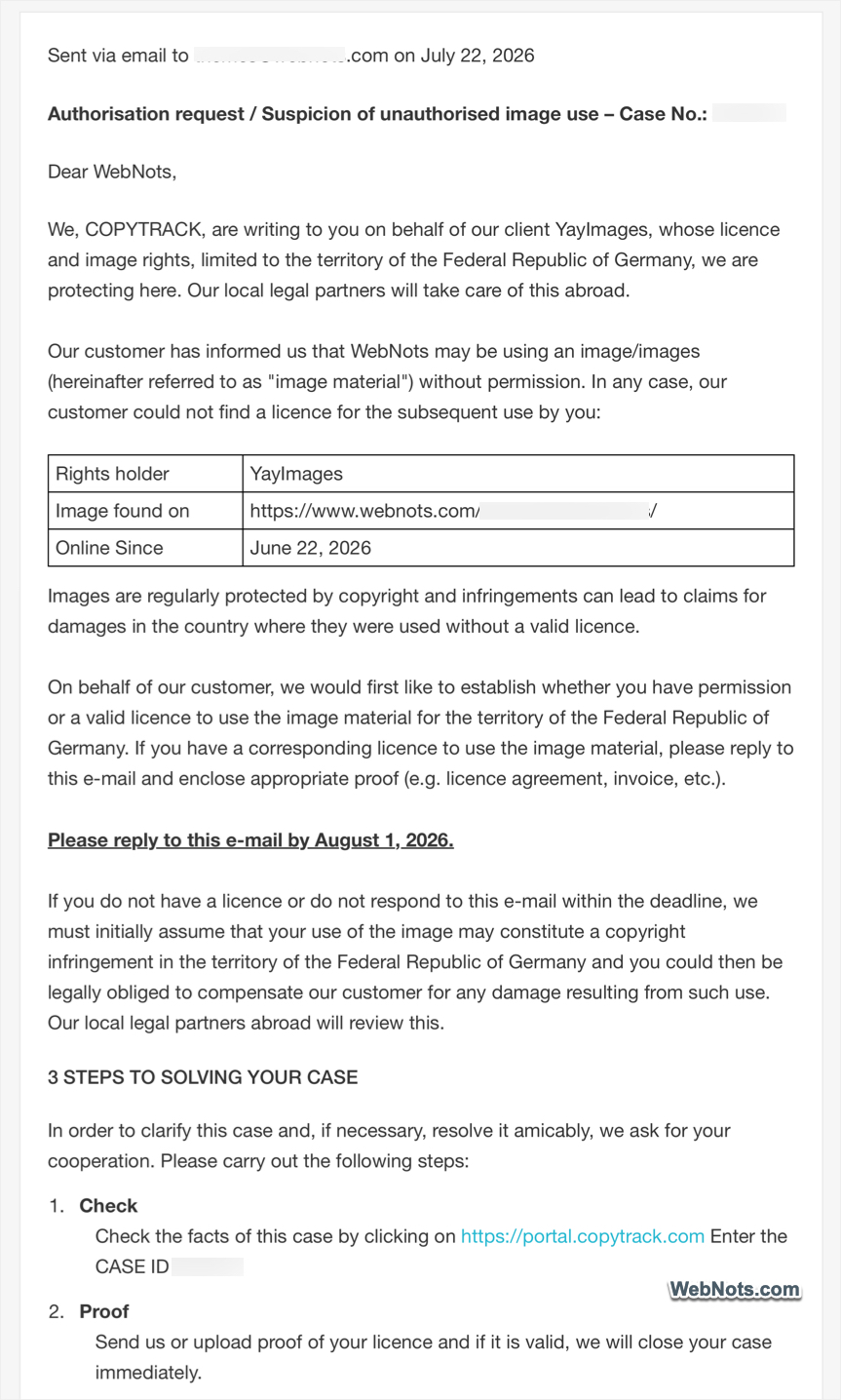
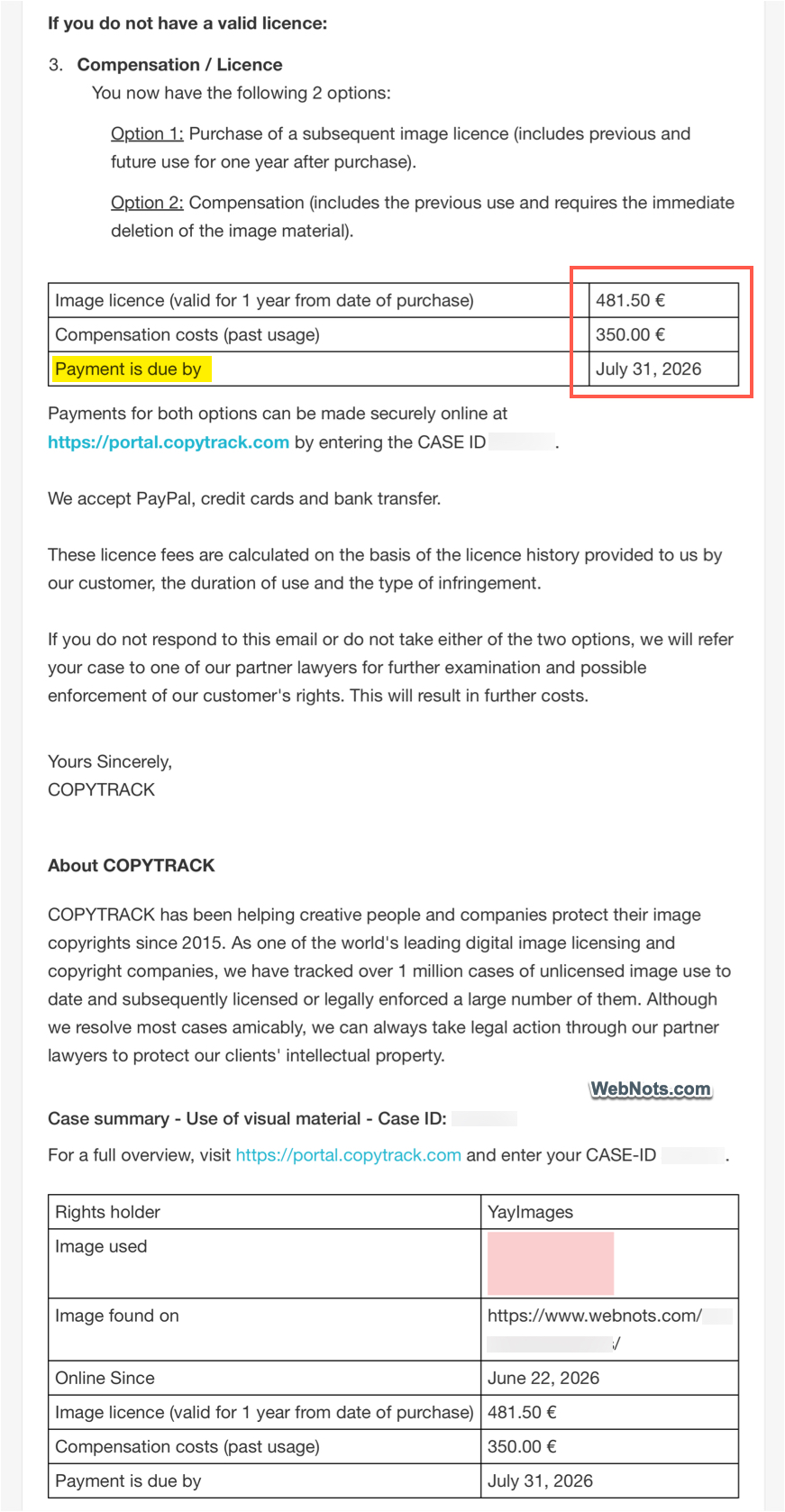
It appears these emails are triggered by an automated scanning service with little to no manual intervention. Here are the reasons these emails raise suspicion:
- Normally, copyright infringement notices are sent via the contact form on a website. Copytrack sent emails directly to various addresses.
- They provided no evidence that their client, YayImages, actually holds a valid license for the image in question.
- They pressured us to pay an unacceptable and disproportionate amount within a very short timeframe.
- The email was generic and contained no personal details about who sent the email.
These are dirty tactics often used by scammers, and no legitimate legal company should send such a scam-like email. Broadly, there are three possible scenarios if you decided to respond:
- You have a valid license for the image.
- You cannot find the license.
- You used the image without a license.
1. Responding to Copytrack When You Have a Valid License
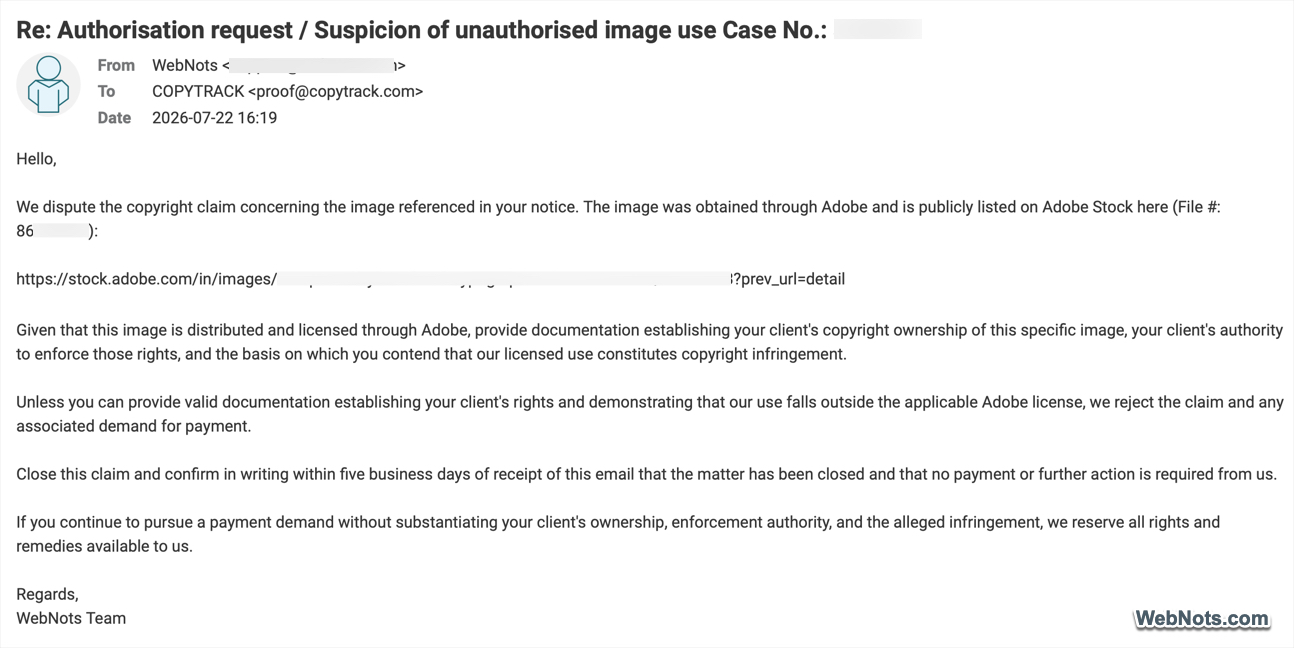
We held a valid license to use the image from Adobe Stock. In that case, receiving continuous copyright infringement emails demanding payment made no sense. We decided to respond clearly with the following points:
- Provide the license details for the subject image. Since Adobe Stock images have public preview pages, it’s easy to include that link.
- Ask Copytrack to provide evidence to substantiate their claim.
- Ask them to close the case and confirm this in writing.
- Mentioned that we may consider taking action against Copytrack if they continue to send emails without evidence.
Further Clarifications
They did not close the case based on our initial response. Adding to our suspicion, we received an instant reply asking for dated proof. Although the response came through a Zendesk portal, it’s an automatic reply from their generic email address [email protected] (which is the same address used for the entire communication). We therefore assume this was also a template designed to ask for clarifications or dated proof, regardless of what your initial response contained.
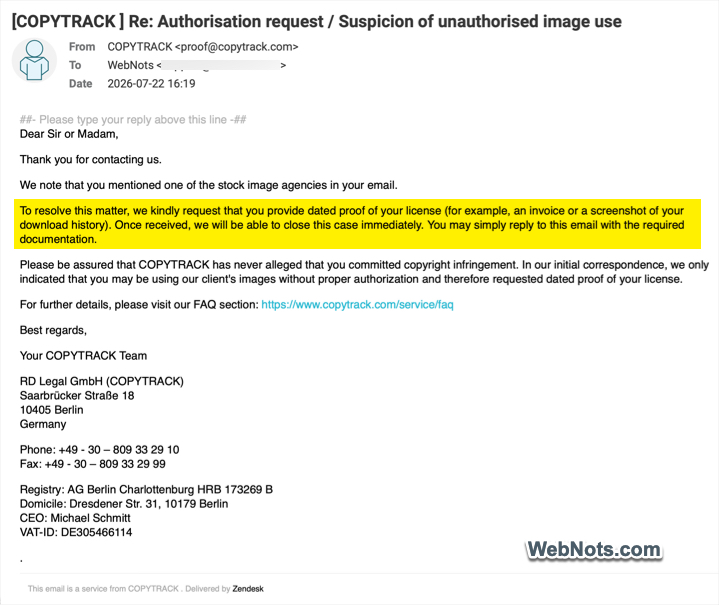
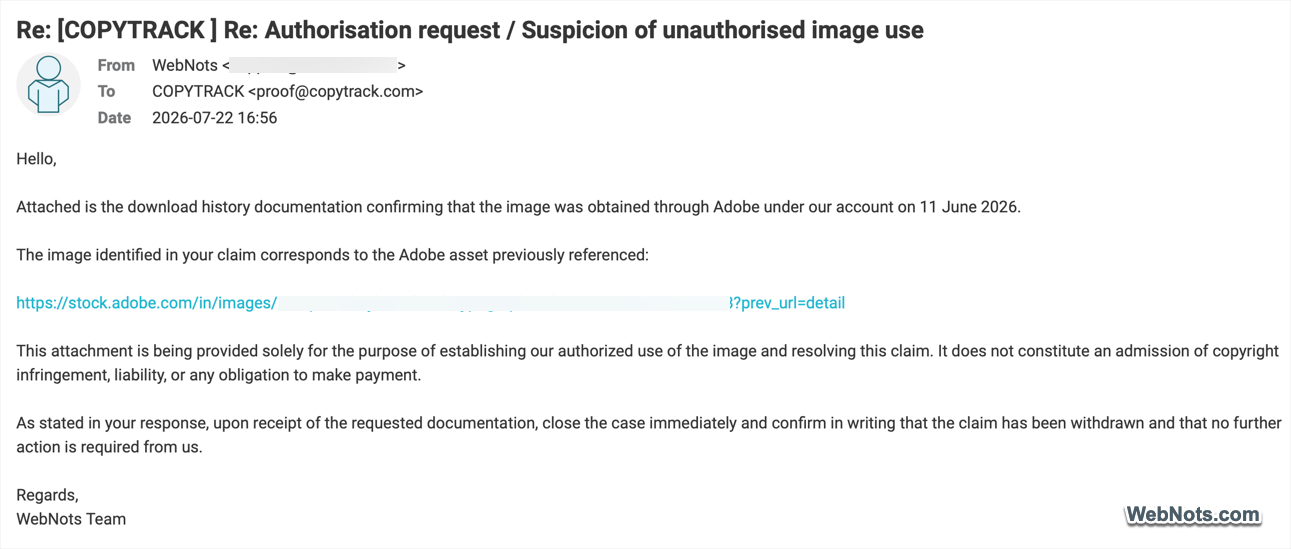
Again, we sent the download history from our Adobe account, which clearly showed the date of download of the subject image.
Confirmation from Copytrack
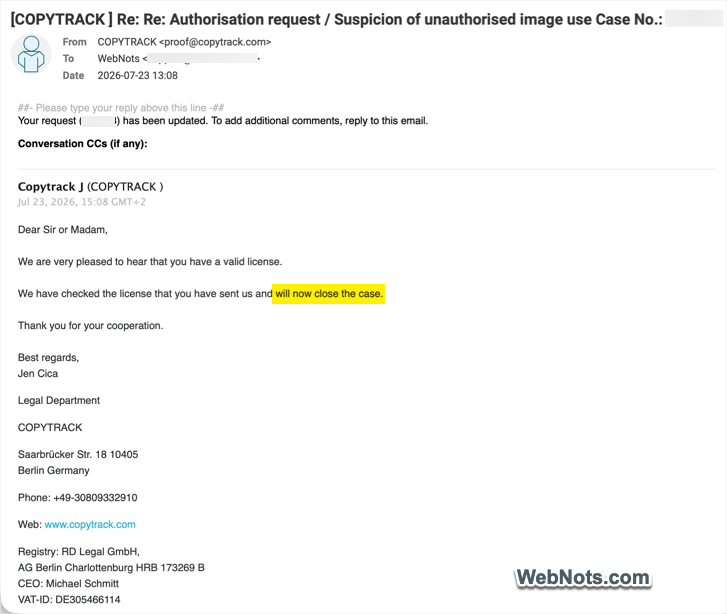
A day later, we received confirmation that the case was closed based on the license details we had provided. We did not receive any further emails from them afterward.
Is Copytrack a Scam?
As you can see, the company itself is not a scam. It is a German-based firm that manages the legal framework for copyright infringement claims on behalf of its clients. However, their practices feel scam-like and are largely unacceptable. They send automated emails with no proof or evidence that their client, YayImages, holds a valid license for the image. Moreover, pushing for €350 for a week’s usage or €481.50 for a yearly license is disproportionate and unreasonable.
If you have a valid license, respond to them as outlined above and close the case.
Points to Consider When Responding
Include the following when writing your response:
- Provide correct license details, such as the stock asset ID, stock image page, licensing or download history, and the date the image was obtained, where available.
- Avoid unnecessary statements such as “I accidentally infringed the image,” “I didn’t realize it was copyrighted,” or “I used it without permission.” Such statements may be inaccurate and can complicate the dispute unnecessarily. If you have a valid license, the relevant fact is that your use was authorized within the scope of that license.
- If the notice lacks sufficient information, request documentation establishing the basis of the claim. The goal is not to argue aggressively but to establish the facts.
- Do not assume the matter is over simply because you submitted your license. Ensure the case is formally closed and obtain written confirmation.
2. What If You Cannot Find the License?
The situation becomes more complicated if you cannot find an evidence of a license but know where the image came from. This is common, as most stock image providers do not issue separate license certificates for individual images. Additionally, you might use an image via different channels without accessing the stock portal directly. For example, Adobe Express allows the use of Adobe Stock images, and you may not hold a separate license record in this case.
Removing the image may be prudent in some cases, but removal alone does not resolve questions about past use. Another important point is that the stock images (both premium and free) are created by individual contributors and offered through platforms like Adobe, Pixabay, DepositPhotos, etc., under specific licenses. Therefore, there is a possibility of copyright infringement by the creators themselves. If you have doubts, reach out to the platform’s support team and confirm how you should respond to Copytrack. We also chatted with Adobe’s support representative before responding even though we had the necessary details.
3. Used an Image Without a License
This is where the situation becomes more serious. Many website owners mistakenly assume that images found through Google and other search engines are free to use. They are not.
- If you downloaded an image found through Google and used it on your website without checking its license, do not falsely claim that you purchased or licensed it. Instead, investigate the image before responding to a copyright demand.
- Use reverse image search and other available information to locate the original source. Determine whether the image is copyrighted, in the public domain, available under a Creative Commons license, or offered through a stock photography service.
- If a designer or agency built your website, ask them where the image originated and request the relevant licensing documentation.
- If you cannot establish permission or a valid license, consider removing the image promptly to prevent continued use while you investigate. However, removing the image does not automatically resolve a claim concerning its prior use. At the same time, the absence of a license does not mean you should automatically pay whatever amount is demanded in an unsolicited email.
Generally, the first step in legitimate communication is a takedown request via email or a DMCA notice (refer our article on how to counter notice a DMCA takedown request). However, companies like Copytrack often skip this and demand direct payment for usage. Therefore, verify the claimant and request sufficient information establishing who owns the image, the claimant’s authority to act on behalf of the copyright owner, and the basis for the amount demanded.
If the claim appears legitimate and you cannot establish a license or another valid legal basis for using the image, the situation is materially different from a mistaken claim against a properly licensed stock image. Depending on the amount demanded and the circumstances, obtaining advice from a qualified copyright attorney may be appropriate before admitting liability, negotiating a settlement, or making a payment.
The Key Lesson
A threatening copyright email from Copytrack (or any other similar company) is a mere claim and not by itself proof that you infringed copyright or owe money. This is actually mentioned in their emails as well. When a copyright notice arrives, investigate first, document your rights, respond with facts, and do not make a payment simply because an email demands one. The most important habit for website owners is therefore simple: know where your images come from and keep evidence of your licenses.
Disclaimer: This article reflects our experience when we had a valid license. The information provided regarding scenarios where you do not have a license is for informational purposes only and does not constitute legal advice. Copyright law and licensing rights vary by jurisdiction and circumstances. Consult a qualified attorney if you need advice regarding a specific copyright claim.