
MAMP is a free app used to setup a local server environment and install WordPress on local PC or Mac. As with every software, MAMP is also updated frequently. You need to update your app to the latest version to ensure the localhost site can work properly. It is a good idea to develop and test on the latest version which exactly works like production environment. In this article, let us discuss how to update MAMP to new version on your localhost. Check out complete list of MAMP tips for WordPress users to work like a pro.
Finding a New Version
Whenever you launch MAMP, the app will automatically check for updates and show you a pop-up with the latest version details. Click on the “Lean More” button to open the official MAMP website.

You can also manually launch the startup page by clicking on the “WebStart” icon on the MAMP application as shown below. However, make sure to first click “Start” to start the server. Otherwise, “WebStart” icon will be frozen and you will not be able to click on it. When you are on the WebStart page, check the current MAMP version and click the update link to go to official MAMP site.

Check on the “MAMP Version” section to see any updates are available for you.
Download Latest Version
When you open the MAMP site from your app, it will automatically detect the correct version for your device. Simply, click on the “Download” button to get the latest version for your device.
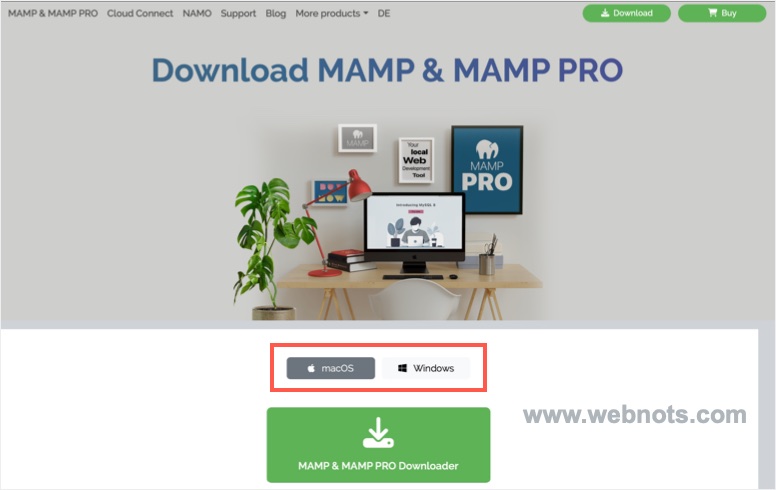
Otherwise, choose macOS or Windows and then click on the “MAMP & MAMP PRO Downloader” to get the correct version. Open the downloader and click on the “Download” button. Note that MAMP has different versions for Intel and M series processors for Mac. After opening the downloader, check the title to make sure the correct version is downloaded. Otherwise, click on the “Show all versions” link to find and download the correct version for your device’s processor.

It will take sometime to completely download the package file. Launch the installer by double-clicking on the installation package (from Downloads folder) and navigate through the process.

MAMP Free and Pro Versions
The downloaded package file contains MAMP and MAMP Pro demo versions. Earlier, you had an option to try out MAMP-Pro and upgrade to the full version or only install MAMP without Pro trail during installation. You could choose this by clicking on the “Customize” button when you are on the “Installation Type” section. On the next screen, uncheck “MAMP PRO” option and continue your installation. This would ignore Pro version and only install the free MAMP version on your computer.


Unfortunately, this option has been removed in the latest installation package which means you have no option to exclude MAMP Pro. Do not worry and simply continue the installation process. You can later uninstall or delete only the Pro version without affecting free MAMP version.

You will see a success message once the installation is finished.

MAMP will prompt whether automatically delete the installer package. You can select “Yes” to delete the installer package or manually delete the package file later.

Ensure to logout of your localhost site and the MAMP server during installation process. You will get the below warning message if you are logged into the MAMP server and the installation will fail without completion. You need to start the installation process from the beginning again.

Launching Updated MAMP Version
Unlike other application upgrade, updating MAMP server will change the existing application folder with the timestamp of installation added like “MAMP_2022-10-16_23-31-2”. It will create a new folder with the name MAMP which will contain all your localhost site files and the upgraded MAMP application. You can open the latest MAMP app from this MAMP folder.

You can launch the local site without deleting the old folder with timestamp, as your default document root will be pointing to “Applications > MAMP > htdocs” folder. Once local site can be opened successfully check the MAMP version is showing the latest in the WebStart page.

After testing everything is working fine, you can simply delete the MAMP folder with timestamp. In addition, make sure to uninstall MAMP Pro app if you do not want to use the demo version. This will help to save large space in your hard disk.
Upgrading MySQL Database
Sometimes, you may need to upgrade the MySQL database version when the MAMP version is updated. In this case, MAMP will take the backup of your database to the latest compatible version and show you the message before completion of the installation.

You can either upgrade the database from “Tools” menu on the webstart page or you will be prompted to upgrade on the application launch pad as shown below:

Just click on the “OK” button and click on the “Upgrade” to update the database to the latest version. You will see the update running and complete with “OK” status for all items.

Now that your database is updated along with the latest MAMP version. If MAMP does not work after updating, then port setup is the first thing you should check. Open the app and go to “Preferences > Ports” section. If you are using localhost URL then click “80 & 3306” button and click “MAMP default” button if you are using localhost:8888 URL.

If the app is still not working on your Mac after update, check our detailed guide on how to fix MAMP not working issue in macOS.





Thanks for sharing this! While updating MAMP is a good solution for some, if you’re looking for something with more flexibility and modern features, I’d recommend ServBay. It allows you to easily manage multiple PHP versions, MariaDB, PostgreSQL, Redis, and Memcached, all in one simple interface
u got the folders mixed up. when you install a new version, the folder mamp *IS* the one, while the old one will be renamed to mamp_yymmdd.
Thanks for mentioning, the article is corrected accordingly.