Domain Name is a unique name identifying a website on the Internet. The site address entered in a browser is resolved to an IP address for looking up the requested content. Since it is difficult to remember IP addresses of many sites, domain names are used as a human memorable names equivalent to the numeral IP addresses for the sake of easiness. Whether you’re planning to launch a website, start a blog, or build a business online, understanding domain names is one of the first and most important steps. This guide breaks down everything you need to know, from the basics to the registration process and beyond.
1. The Structure of a Domain Name
A domain name isn’t just a single label, it has a hierarchical structure, read from right to left. Let’s break down https://www.blog.example.com:
| Part | Name | Description |
|---|---|---|
| .com | Top-Level Domain (TLD) | The highest level in the domain hierarchy. Indicates the category or country. |
| example | Second-Level Domain (SLD) | The core, unique name you choose. This is usually your brand, business, or project name. |
| blog | Subdomain | An optional prefix used to organize sections of a website like blog, shop, or forum. |
| www | Subdomain (legacy) | Traditionally stands for World Wide Web. Nowadays, most sites work with or without it. |
| https:// | Secured Transmission protocol | Hyper Text Transfer Protocol used for sending and receiving data. |
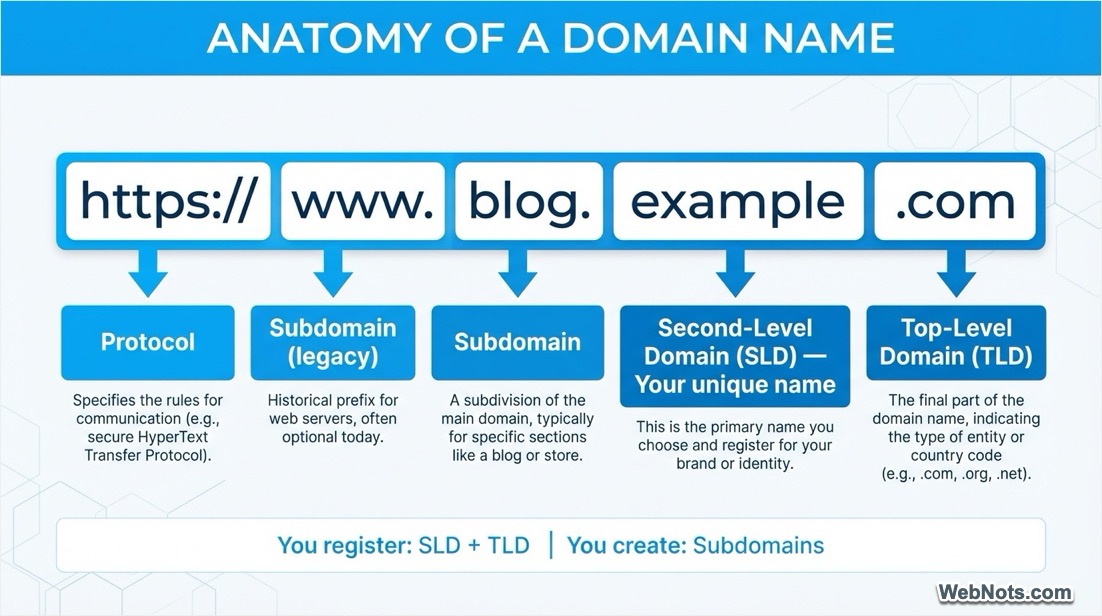
You register the SLD + TLD combination (like example.com) and create subdomains (like shop.example.com) from your hosting account. These subdomains don’t cost extra.
2. Types of Domain Names (Domain Extensions)
More than 90% of the websites use one of the popular extensions like .com, .net or .org. However, there are more than 100 domain extensions available for you to choose like .ai, .online, .store, .life. .vip, etc. Sites like GoDaddy will suggest different domain extensions when the searched .com domain is not available for sale. As you can see, same name costs you differently based on the domain extension and the duration of registration. For example, .ai extension will cost $59.99 for the first year for two years registration. Make sure to understand the renewal price which is much more than the initial offer.

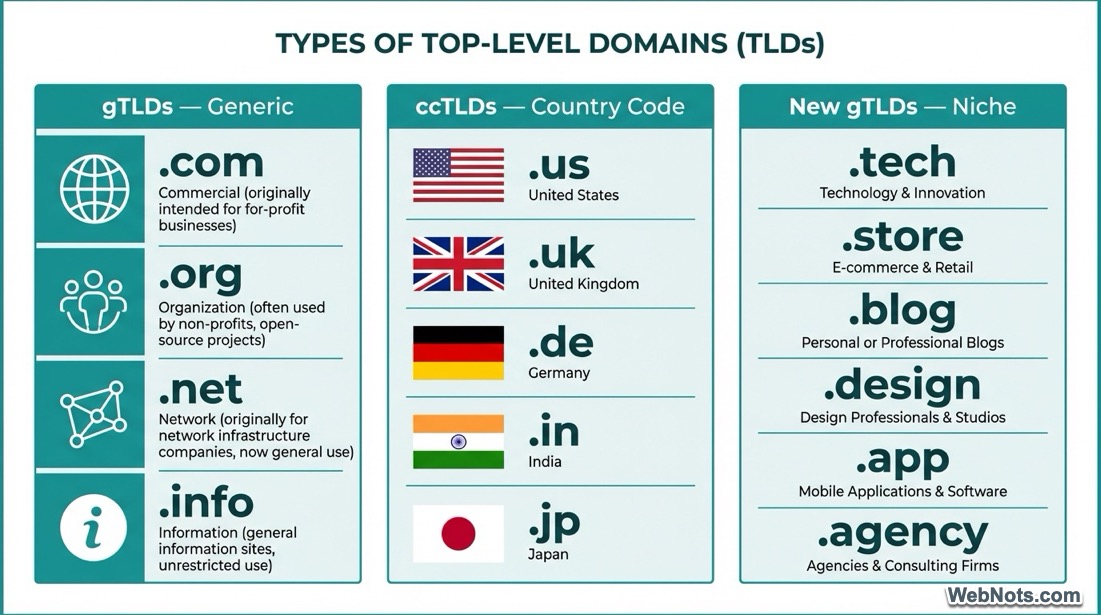
Domain names are categorized primarily by their Top-Level Domain (TLD). Here are the main types:
2.1. Generic Top-Level Domains (gTLDs)
These are the most common and widely recognized TLDs. They are not tied to any country.
| TLD | Originally Intended For |
|---|---|
| .com | Commercial businesses (now universal) |
| .org | Organizations & nonprofits |
| .net | Network-related services |
| .info | Informational sites |
| .biz | Businesses |
2.2. Country-Code Top-Level Domains (ccTLDs)
These are two-letter TLDs assigned to specific countries or territories.
| TLD | Country |
|---|---|
| .us | United States |
| .uk | United Kingdom |
| .de | Germany |
| .in | India |
| .jp | Japan |
| .au | Australia |
For example, google.com is a global domain primarily used in USA and the country specific domains include google.co.jp for Japan and google.co.in for India. If your business targets a specific country, using its ccTLD can boost local search visibility and build trust with local customers.
2.3. New / Sponsored gTLDs
Since 2014, hundreds of new and more descriptive TLDs have been introduced:
| TLD | Best For |
|---|---|
| .tech | Technology companies |
| .store | Ecommerce businesses |
| .blog | Bloggers & content creators |
| .design | Designers & creative agencies |
| .app | App developers |
| .agency | Marketing & creative agencies |
| .photography | Photographers |
| .ai | For Artificial Intelligence companies |
2.4. Sponsored Top-Level Domains (sTLDs)
These are restricted TLDs managed by specific organizations and have eligibility requirements:
- .edu – Accredited educational institutions
- .gov – U.S. government entities
- .mil – U.S. military
- .museum – Museums
3. Domain Name vs. URL vs. Website
These terms are often confused, but they mean different things:
| Term | What It Is | Example |
|---|---|---|
| Domain Name | The address/name of the website | example.com |
| URL | The full path to a specific page | https://www.example.com/blog/article |
| Website | The collection of web pages and content hosted at a domain | The pages you see when you visit example.com |
A domain name is part of a URL, and a website lives at a domain name.
4. Importance of DNS
When an URL is entered in the browser running on a local client computer, the browser gets the DNS server details from the network settings of your computer. DNS servers will have the required mapping of domain names to IP address and work like a network structure in hierarchy.
If the first DNS server does not have the mapping it will request the next level DNS server 2. This will continue till the time the IP address is obtained and the same is returned to the browser. (You will see a resolving host message till the time browser gets the IP address of the site you entered).
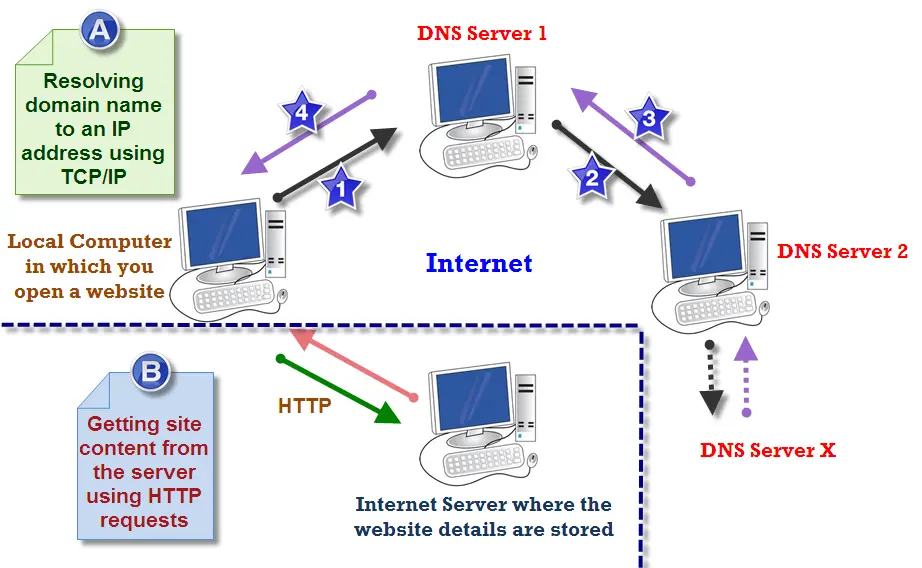
DNS caching is used in every level including your browser and local computer in order to save time during this resolving host process. This means browser and DNS servers cache the IP address of the host names and use it when the same request is requested next time though the real mapping is not available. Here is another issue of IP change, if the IP is changed for a particular site you try open, then the cached IP returned by the DNS servers will not match with the new IP of the site. Again browser will try to resolve the host till the time it gets the correct IP.
Think of it this way: A domain name is like a contact name in your phone. You don’t memorize phone numbers, you just tap the name. DNS does the same for websites.
5. How Browser Displays a Webpage?
This whole communication happens through TCP/IP protocol structured in every computer. Once the IP address is known, the browser will directly broadcast request to the server through Hyper Text Transfer Protocol (HTTP) and get the required HTML code of the webpage. The codes are then interpreted by the browser to display it in a readable format and you see an attractive webpage.

Note: It is not necessary that all domain names should be associated with an IP address. It is also not necessary that all domain names should be associated with a unique IP address. For example, in shared hosting scenario many domains are mapped to a single IP address.
6. Who Manages and Maintains Domain Names?
The domain name system is managed through a layered governance structure:
- ICANN (Internet Corporation for Assigned Names and Numbers): A nonprofit organization responsible for coordinating domain name policies, IP address allocation, and protocol standards. ICANN does not sell domain names directly.
- Domain Registries: Organizations that manage specific TLDs. They maintain the master database of all domain names under their TLD. For examples, Verisign manages .com and .net and Public Interest Registry manages .org.
- Domain Registrars: These are ICANN-accredited companies that sell domain names to the public and act as the middlemen between you (the registrant) and the registry. Examples include SiteGround, GoDaddy, Namecheap, and others.
- Registrants (You!): The person or organization that registers and uses the domain name. You don’t technically own a domain, you lease it for a period (typically 1–10 years) and must renew it to keep it.
7. How to Register a Domain Name?
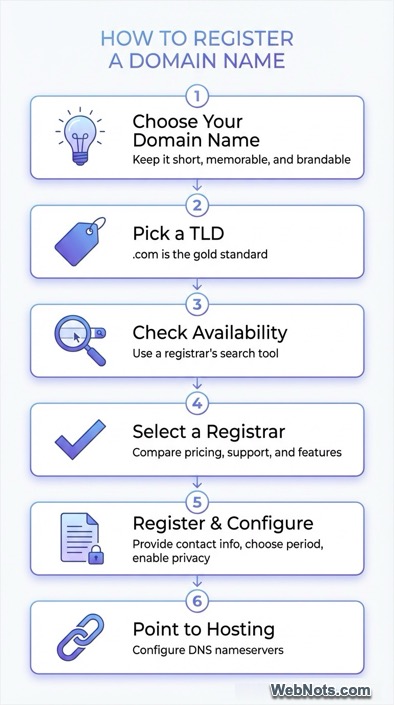
As mentioned above, domain names are to be registered with the domain registrars like GoDaddy who are authorized by ICANN (Internet Corporation for Assigned Names And Numbers). The domain name registration fee includes the fee for registrar, the fee for ICANN, which can range anywhere between free to $15 per month. Generally domain names are offered as a free add-on service for one year along with main hosting or site building services.

Domain names are registered for a particular period of time and needs to be extended before it expires for further duration. Search engines may also consider the length of domain registration period since it indicates the planned online presence of a site. Note that it is also possible to buy a domain from one registrar and then transfer to another. Below infographic explains the entire process:
Tips for Choosing the Perfect Domain Name:
- Keep it short: Aim for 6–14 characters. Shorter is easier to remember and type.
- Make it brandable: Unique, catchy names are more memorable than generic ones.
- Avoid hyphens and numbers: They cause confusion and look less professional.
- Use keywords wisely: A relevant keyword can help, but don’t force it.
- Check for trademarks: Make sure your domain doesn’t infringe on existing trademarks.
- Secure multiple extensions: Register .com, .net, and your local ccTLD to protect your brand.
- Think long-term: Your domain name is your digital identity. Choose something that will grow with you.
7.1. Building a Website
Domain name is only an address to your website to connect the pages saved on a hosting server. Once you have purchased a domain the next step is to buy a hosting space and install any content management systems (CMS) on it. There are many CMS like WordPress, Drupal, Joomla, etc. and you can choose the one suitable for your needs. CMS are the frontend helps to create web pages and store it on a hosting server. Visitors can access your web pages stored on a hosting server through your domain name (URL). Learn more on how to create your own blog.
8. What Happens When a Domain Name Expires?
If you don’t renew before the expiration date, a specific lifecycle kicks in:
| Phase | Duration | What Happens |
|---|---|---|
| Grace Period | ~0–45 days after expiry | Your website goes offline, but you can still renew at the normal price. |
| Redemption Period | ~30 days after grace | The domain is removed from the registry. You can recover it, but at a significantly higher fee (often $100–$200+). |
| Pending Delete | ~5 days | The domain is queued for deletion. It cannot be recovered. |
| Released to Public | After deletion | The domain becomes available for anyone to register. |
⚠️ Warning: Expired domains (especially popular ones) are often snapped up by domain squatters or automated bots within seconds of release. If you lose a valuable domain, getting it back can be expensive or impossible.
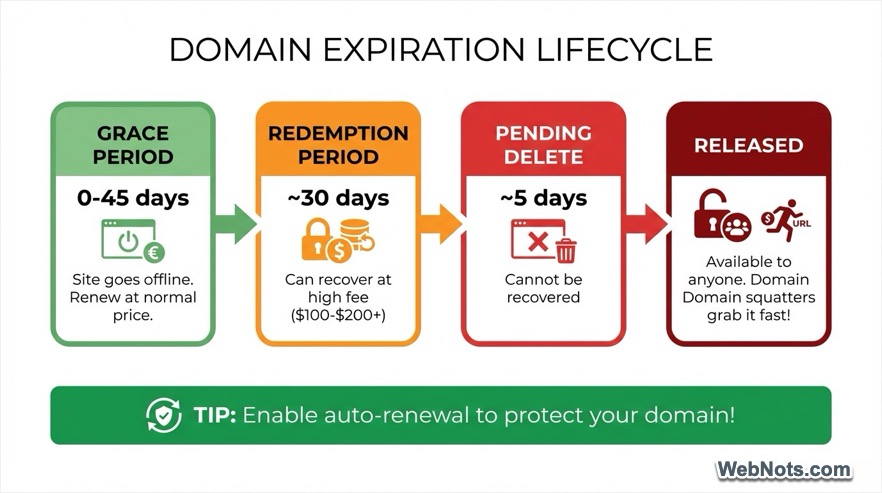
Here are some tips to protect your domain name:
- Enable auto-renewal with your registrar.
- Keep your payment method and contact email up to date.
- Register for multiple years for important domains.
- Set calendar reminders as a backup.
Quick FAQ
Typically $10 to $20/year for standard TLDs like .com. Premium or highly sought-after names can cost significantly more.
Yes. You need hosting to build and display a website, but you can register a domain without hosting for parking or email use.
You can register a new domain, but you can’t rename an existing one. Changing domains means migrating your website and setting up redirects. So, choose the name wisely from the start.
When you register a domain, your contact details (name, address, email, phone) are stored in a public WHOIS database. Most registrars offer WHOIS privacy protection to mask this information and protect you from spam and unwanted contact. Some registrars like GoDaddy also offer additional domain protection against unauthorized changes of your domain details. However, this is a separate premium service and is different from the domain privacy feature (which is free with the domain purchase).
You can transfer your domain from one registrar to another. Generally, the domain must be unlocked and at least 60 days old to become eligible for transfer and you need an authorization code from your current registrar to initiate the process.
If you’ve registered a domain but aren’t ready to build a website, you can park it. A parked domain usually displays a placeholder page and holds the name for future use.
You can set up a domain to redirect visitors to another URL. This is useful if you own multiple variations of your brand name.
Conclusion
A domain name is the foundation of your online presence. It’s how people find you, remember you, and trust you. Understanding how domains work, from their structure and types to registration and renewal, empowers you to make smart decisions as you build your digital footprint. If you’re ready to start a website, pick a name that represents your brand, choose a reliable registrar, and take the first step toward building your online home.