
Unicode is a non-profit organization for standardizing text characters and symbols. UTF-8 (which stands for Unicode Transformation Format – 8-bit) is a popular character encoding standard used to represent text in computers, communication systems, and software. It’s part of the Unicode standard, which aims to provide a unique code for every character from virtually all writing systems in the world, including letters, numbers, symbols, and punctuation marks. UTF-8 is widely used because of its compatibility, efficiency, and versatility.
UTF-8 Encoding
Most applications support UTF-8 by default and Notepad app in Windows is the best example. Whenever you save a file in Notepad, you can see the default encoding is selected as UTF-8. If required, you can also change the encoding to other supported formats like ANSI or UTF-16.
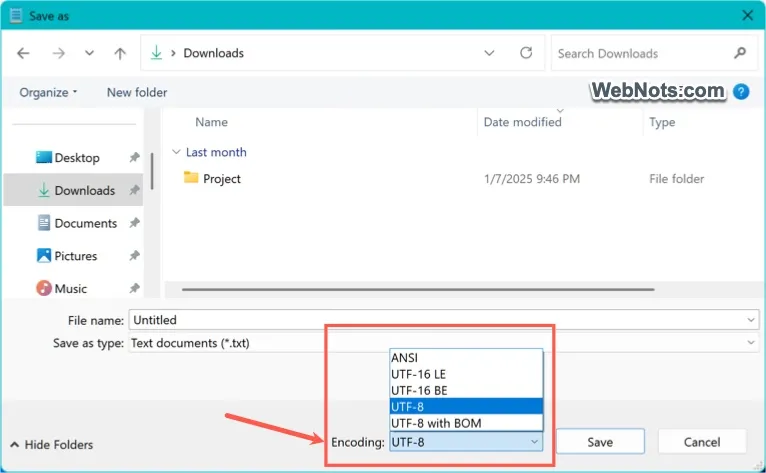
Other popular apps like Excel and Word also support UTF-8. Below are some of the characteristics of UTF-8 character encoding.
1. Variable-Length Encoding
Non-ASCII characters like accented characters or symbols from non-Latin alphabets use 2 to 4 bytes and ASCII characters like the basic Latin alphabet and common symbols use 1 byte. However, UTF-8 uses a variable number of bytes from 1 to 4 to represent characters.
2. Backward Compatibility with ASCII
The first 128 Unicode characters (which include the standard ASCII characters like A, B, C, 1, 2, 3, etc.) are represented using a single byte. This means that UTF-8 is fully compatible with ASCII, making it easy to use in systems that already rely on ASCII.
3. Efficient Storage
Because UTF-8 uses 1 byte for common characters like English letters, it is memory-efficient when working with English text or other languages that use the Latin alphabet. For characters that require more than one byte as with Asian language characters like Chinese, the use of multiple bytes still allows UTF-8 to handle a large variety of languages.
4. Self-Synchronizing
UTF-8 is designed to be self-synchronizing, meaning that if you know where the beginning of a character is, you can easily skip over it, even if the encoding is incomplete. This is helpful in situations like streaming data or parsing.
5. Widely Supported
UTF-8 is the most common character encoding on the web and is supported by virtually every modern programming language, operating system, and database. For example, HTML and XML documents use UTF-8 by default. It’s also the default encoding in many programming environments like Python, JavaScript, and modern web development. Since UTF-8 can represent any character in the Unicode standard, it is suitable for globalized applications that require support for multiple languages and special symbols.
Bytes Used in UTF-8 Encoding
As mentioned, up to 4 bytes are used for a single character depending on the case.
| Byte(s) | Characters Range | Examples |
|---|---|---|
| 1 | 0 – 127 | Basic Latin characters and English alphabets. |
| 2 | 128 – 2047 | Accented letters, Cyrillic and Greek alphabets. |
| 3 | 2048 – 65535 | Chinese, Japanese and Arabic characters. |
| 4 | 65536 – 111411 | Rare characters, historical scripts, emojis and other symbols. |
Here are some of the examples of how many bytes a character uses in UTF-8 encoding:
- The letter A is represented as 41 in hexadecimal, which is 1 byte.
- The character é (lowercase e with an acute accent) is represented by the two-byte sequence C3 A9.
- The emoji 😊 (smiling face with smiling eyes) is represented by the four-byte sequence F0 9F 98 8A.
Why UTF-8 is Important?
Here are some of the reasons why all applications use UTF-8 as a standard encoding or at least support it.
1. Globalization
UTF-8 allows systems to support multiple languages in a single environment, making it essential for global applications. It enables seamless handling of characters from different languages (like Chinese, Arabic, or Hindi) alongside Western alphabets.
2. Web and Internet
UTF-8 is the dominant character encoding used on the web. Almost all web pages, APIs, and modern web services use UTF-8, ensuring that content can be viewed correctly regardless of the user’s language or region.
3. No Data Loss
Unlike some older encoding systems (e.g., ASCII, ISO-8859-1), UTF-8 can represent any character without losing information, making it robust for working with international data.
4. Efficient and Compact
For most characters, especially English text, UTF-8 is more compact than other Unicode encodings like UTF-16 or UTF-32.
UTF-8 Vs UTF-32
UTF-16 uses 2 bytes for most characters and 4 bytes for supplementary characters, making it more space-efficient for texts with a lot of non-ASCII characters, like many Asian languages. However, it isn’t backward-compatible with ASCII and can introduce issues with byte order due to its use of endianness in computing.
While UTF-8 is preferred for web and multi-platform environments due to its compactness and universal support, UTF-16 is more common in environments like Java and Windows, where text primarily involves characters from the Basic Multilingual Plane. Each encoding has its strengths depending on the data and context in which it’s used.
Conclusion
UTF-8 is a highly efficient, flexible, and universally adopted character encoding system that enables the representation of virtually every character used in modern languages and systems. Its backward compatibility with ASCII, variable-length structure, and support for a wide range of characters make it the preferred encoding for the internet, software, and data storage worldwide.


Hy i have been going through an issue with an encoding part.
where actual input is an E-Newspaper pdf which is in indian local language, but when i extract the text and summary of the news papers, it is not in the same languages as I see.
ex: it is in languages like
������� �������
������ �������� ��� like this or
L f N j ¾ûY Rôû W Yô o j RÕ Vô o? like this!
so, how can we sort it out!
Make sure the app you use for extracting content from PDF supports the local language’s font.