In the rapidly evolving world of artificial intelligence, Microsoft has once again pushed the boundaries of creativity with the introduction of Copilot 3D, an experimental feature designed to transform 2D images into usable 3D models with just a few clicks. Launched as part of Copilot Labs, this innovative tool aims to democratize 3D content creation, making it accessible to everyone from hobbyists to professional designers. Here’s an in-depth look at what Copilot 3D is, how it works, its potential applications, and the challenges it faces as it moves toward broader adoption.
What is Copilot 3D?
You might have already know that Microsoft retired Paint 3D app. Copilot 3D is different and an AI-powered tool that allows users to convert images into a fully rendered 3D model. At this point, it’s an online tool and not available as an app.
Input:
- Users can either upload a single 2D image or select from the available image.
- Image should be in PNG or JPG format and the size allowed is under 10MB.
Output:
- The tool generates 3D models in the widely compatible GLB format, which can be used in various 3D viewers, design tools, game engines, and even augmented reality (AR) applications.
- Generated models are stored in a user’s “My Creations” page for 28 days, allowing for easy access and further manipulation.
Unlike traditional 3D modeling software, which often requires specialized skills and complex workflows, Copilot 3D simplifies the process to a near one-click experience. The feature is currently available to a subset of users through Copilot Labs, Microsoft’s experimental platform for testing new AI capabilities, and requires a personal Microsoft account to access.
How Does Copilot 3D Work?
Using Copilot 3D is straightforward and designed for accessibility. The tool is available for use with sample images without requiring a Microsoft account login. However, uploading your own image requires logging in. Downloading and saving the history is also only possible when logged in. Here’s how it works:
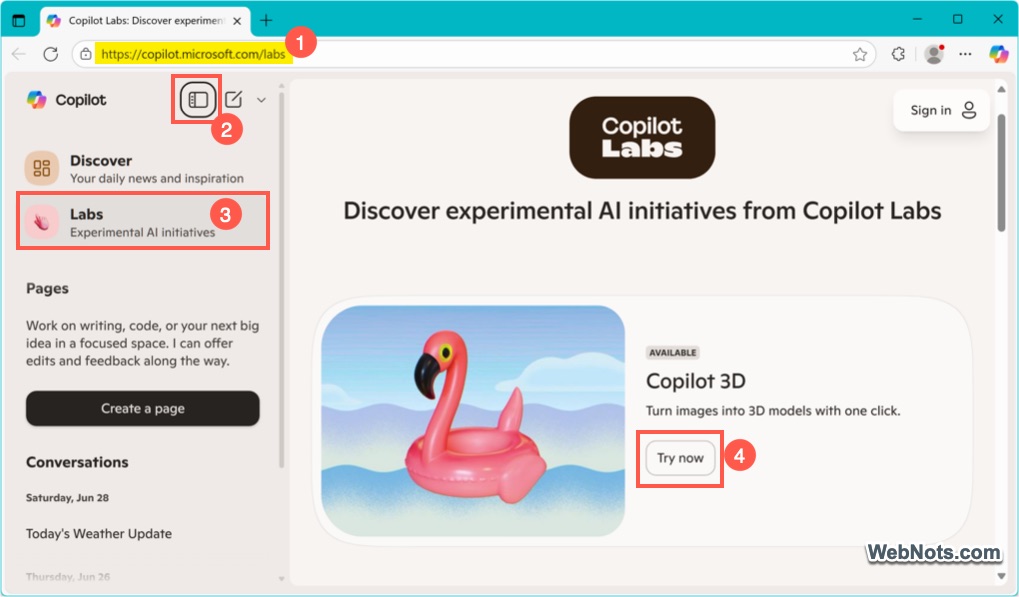
- Visit the official Microsoft Copilot website and login with your account. Microsoft recommends using a desktop browser for the best experience, as mobile browsers may encounter issues.
- Click the sidebar button on top left and select “Labs” option.
- You will find a list of experimental features and choose Copilot 3D.
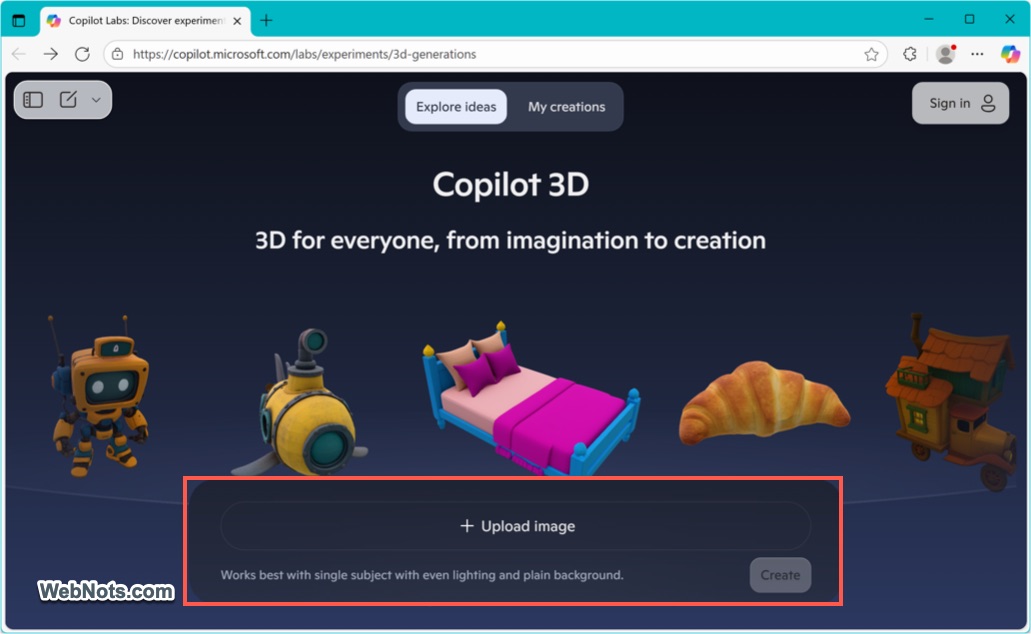
- Click the “+ Upload image” option to browse and upload your image. For optimal results, Microsoft suggests using images with a clear subject and a distinct background to help the AI accurately interpret the object.
- After uploading, click the “Create” button. The AI processes the image, taking anywhere from a few seconds to a minute, to produce a 3D model.
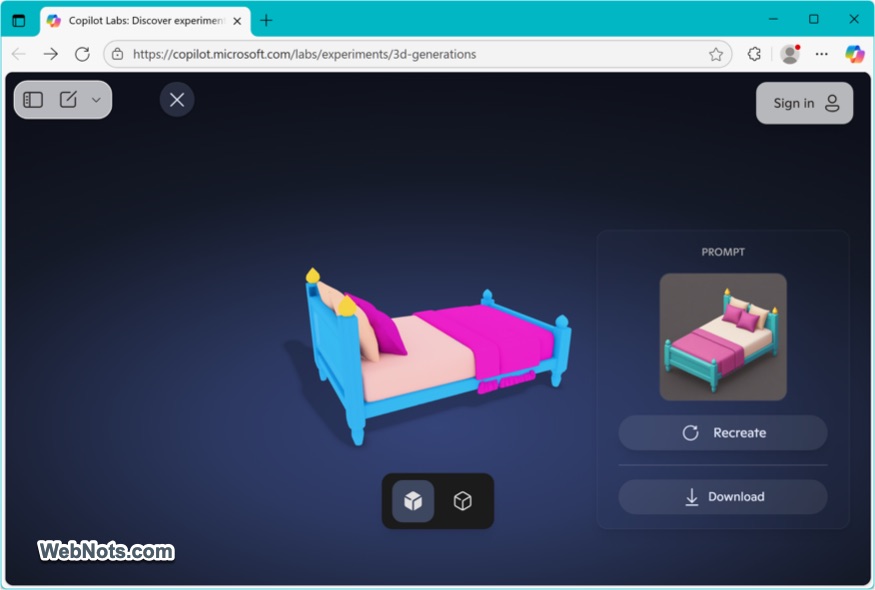
Downloading and Accessing History
You can then view, rotate, and interact with the model in the Copilot 3D interface. Simply click the “Download” button to get the GLB format 3D model file. The tool’s interface includes a “My Creations” gallery for managing generated models and a “Recreate” button for duplicating or iterating on previous outputs, streamlining the creative process.
You can also browse a curated library of 3D models for inspiration (available on the Copilot 3D homepage).
Note: Microsoft emphasizes that uploaded images are not used for AI training or personalization. Always use images you own to avoid copyright issues, and check Microsoft’s terms of service for the latest guidelines.
Key Advantages of Copilot 3D
Copilot 3D stands out for its simplicity and integration within the Copilot ecosystem, which is already familiar to millions of users through Windows and Microsoft 365. Key strengths include:
- Ease of Use: The one-click workflow eliminates the steep learning curve associated with 3D modeling, making it accessible to beginners.
- Cloud-Based Workflow: The “My Creations” gallery and cloud storage enable seamless management and iteration of 3D assets.
- Broad Compatibility: The GLB format ensures that models can be used across a variety of platforms, from game engines like Unity to AR applications.
- No Subscription Required: Unlike some AI tools, Copilot 3D is currently free for users with a Microsoft account, broadening its accessibility.
Microsoft’s focus on integrating Copilot 3D into its broader AI ecosystem positions it as a potential game-changer for creative workflows, particularly for Windows users and those already using Copilot for other tasks.
Potential Applications and Usage
Copilot 3D has the potential to revolutionize how 3D content is created, particularly for those without advanced technical skills. Its applications span a wide range of fields:
- Game Development: Developers can quickly generate 3D assets for games, reducing the time and cost associated with traditional modeling.
- 3D Printing: Hobbyists and professionals can create printable 3D models from photographs, enabling rapid prototyping and product design.
- Augmented and Virtual Reality (AR/VR): The GLB format is compatible with AR/VR platforms, making Copilot 3D a valuable tool for creating immersive experiences.
- Education and Visualization: Educators can use the tool to create interactive 3D models for teaching, while architects and designers can prototype concepts with minimal effort.
- Animation and Digital Art: Animators can generate 3D models for use in films, animations, or digital art projects, speeding up the creative pipeline.
By lowering the barrier to entry, Copilot 3D opens up 3D content creation to a broader audience, including educators, marketers, and casual creators who may lack the resources or expertise to use traditional 3D modeling tools like Blender or Maya.
Challenges and Limitations
While Copilot 3D is promising, it is still an experimental feature, and early testing reveals several limitations:
- If you test with different images, you can easily find the AI struggles when the image is complex (or has complex objects). Also, uploaded images need a clear subject and background separation as you can see with the examples on the Copilot 3D homepage. This can limit the tool’s versatility for users with less-than-ideal source images.
- Unlike some competing tools, Copilot 3D does not currently support generating 3D models from text prompts, restricting it to image-based inputs.
- As a Copilot Labs feature, there’s no guarantee of long-term support or a clear roadmap for general release. Microsoft’s history with experimental tools, such as the discontinued Paint 3D and Remix3D, raises concerns about Copilot 3D’s future.
- Generating accurate 3D models from a single 2D image is a complex task requiring sophisticated AI techniques, such as estimating hidden surfaces and material properties. Current results suggest that Copilot 3D is not yet on par with professional-grade tools.
The Road Ahead
The future of Copilot 3D depends on Microsoft’s ability to address its current limitations and commit to its development. Microsoft’s strategy appears to focus on integrating Copilot 3D into its broader ecosystem, potentially powering AR/VR applications, educational tools, or even Microsoft 365 workflows (for example – 3D assets in PowerPoint or Teams). This integration could give it an edge over standalone tools, especially if Microsoft improves the AI’s accuracy and expands support for additional file formats or text prompts.