
Freestar is one of the premium ad networks for publishers receiving large amount traffic to their site(s). It is also one of the Google Certified Platforms, so that you can count on them as a reliable partner. If you have been invited or looking for joining their network, here is a genuine review based on our usage. We have used Freestar for a year, hence this review is based on real experience and not written on assumptions.
Publisher Criteria for Freestar
Publisher should receive more than 1 million visitors per month for getting into Freestar network. You may get invitation from their sales representative even if your site gets less traffic. However, make sure to apply only when your site(s) get more than a million visitors. That means, if you are a small or medium scale publisher, be away from Freestar as it will not work for you (check payment process section below to understand why it will not work).
In addition to traffic, you need to provide last 2 to 3 months data for:
- Current ad revenue.
- Access to your Google Analytics.
Features and Products Offered by Freestar
It’s the same header bidding process Freestar uses like other ad networks. However, unlike Raptive, Mediavine and many other ad networks, Freestar offers a complete package in one place. You have both display and video ads in different formats:
- Display ads – banner, interstitial, sticky footer / header, sidewall, sticky slide ads.
- Videos ads – adhesion player, inbound / outbound video ads.
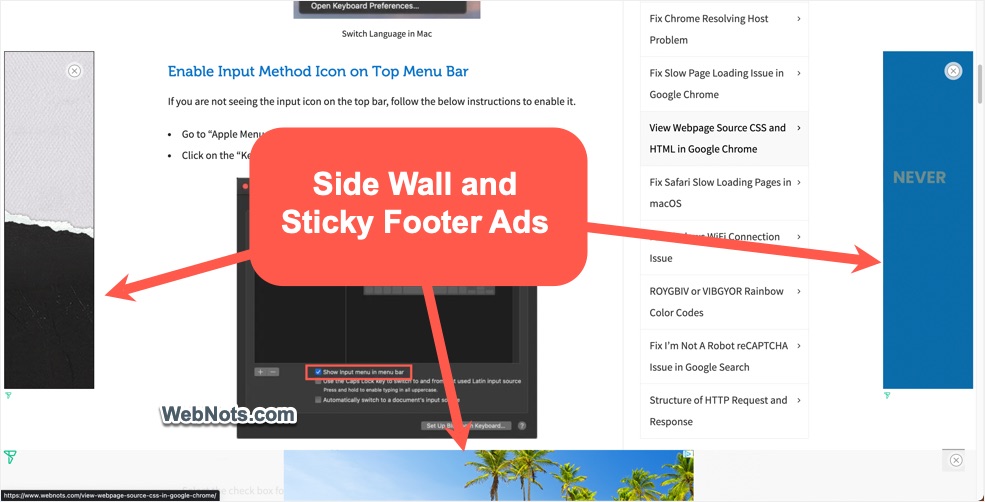
You will get the following features which will make Freestar stand out from other networks:
- Superflex – this ad will accommodate multiple ads in a single slot thus allowing to make more impressions.
- 30 seconds refresh rate – all ads will be automatically rotate with 30 seconds refresh rate.
- Dynamic Ads – when enabled, this will automatically insert display ads in-between your content.
- Ad Recovery – bypass ad blockers and show limited ads.
- CMP – Consent Management Platform to get user’s consent to show ads on UK and certain geographical locations in USA like California.
You can check the demo of various ad units on their official ad products page.

Onboarding Process
Freestar’s customer success team is quite good, knowledgeable and responsive. So, you will not have any hurdles when onboarding.
- They will provide you the Freestar publisher code which you should add in your ads.txt file.
- After verifying your Google Analytics data, you should confirm the inventory usage in Google Ad Manager (MCM) and wait for Freestar guys to get the approval from Google.
- Customer support will analyze your site’s current revenue model and suggest a strategy for replacing it with Freestar ads. Once agreed, they will create required ad units and enable the products for your site (like CMP).
By this time, you will have access to onboarding portal where you can fill out the details for go live and ask any clarifications if you have.
Ad Code Implementation
Once the go live date is agreed upon, you will get complete access to Publisher Dashboard (which is different from onboarding portal). You can either setup .htaccess redirect to point to Freestar ads.txt or copy / paste their line items in ads.txt file located on your server.
- Header code will enable interstitials, sticky, CMP and other site wide stuffs.
- Individual ad unit code allows to display ads on particular placement.
- You need to create separate code for ad recovery and include in the header.
This is pretty much standard process like Google AdSense. However, different than some networks like Raptive which works based on automatic insertion. With Freestar, you should manually insert each ad unit as per the desired position on your site. As mentioned, you do have an option for dynamic in-content ads which you can request the customer service team to enable.
Freestar Publisher Dashboard
Since Freestar completely works based on CPM, Publisher Dashboard will show you relevant details for pageviews, CPM, revenue, ad impressions, etc. You can get the detailed report based on each property, country, ad unit for various timeframes. The details are updated every few hours and not on real time.
- Advanced Reporting – you can schedule various reports and receive them in email.
- Site Configuration – get your ad tags, check ads.txt status and publish ad blocker recovery pop-up.
- Payments – add you bank or PayPal details.

My Documents and Additional Resources sections offer help and account specific documents for you.
Payment Process
Freestar uses Tipalti as a payment partner with net 60 days payment term. This means, you will get your March month payment at the end of May month (after 60 days). You can also get the payment through PayPal. Other than standard deductions and transaction fee, there is a “Monthly Minimum Fee” which is a bad thing for small/medium scale publishers. Freestar works based on 80/20 revenue sharing model which means, you will get 80% revenue while Freestar will get 20% as commission. This so called “Monthly Minimum Fee” is an additional fee which they will deduct if their 20% share is less than $1000. In this case, you should make $5000 as a minimum gross revenue to make sure Freestar will get $1000 (20%). Otherwise, they will deduct the remaining amount from your payment as a “Monthly Minimum Fee”.
On top of these, there are also nominal deductions for MCM revenue, Consent Management System and 3rd party optimizations as you can see in the payment history example below.
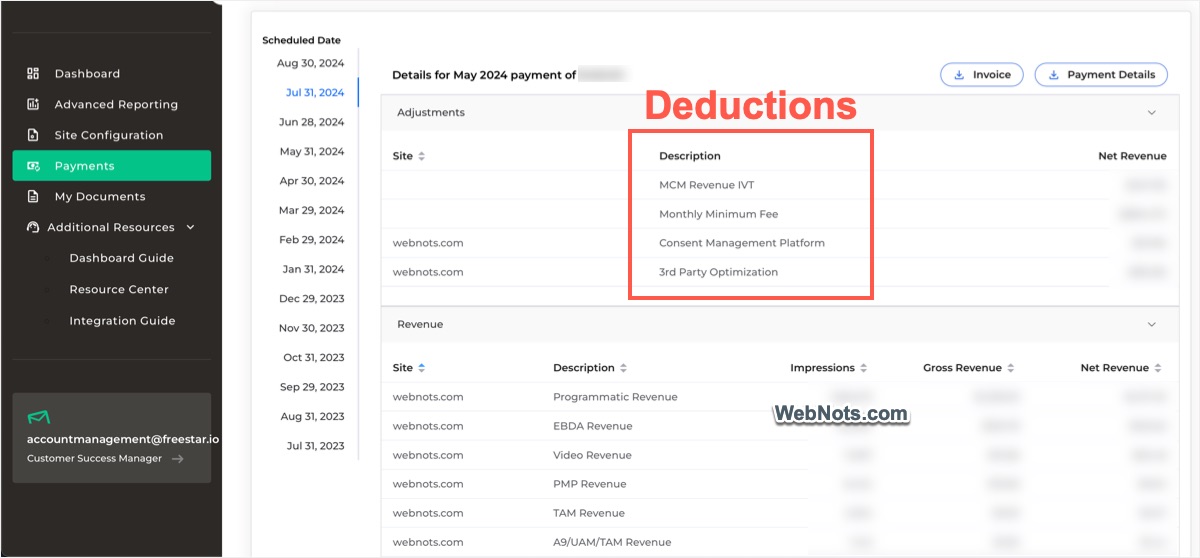
Let’s do a simple math – if you make $4000 gross revenue per month, here is an approximate payment you will get:
- Gross revenue – $4000.
- Net revenue (80% of your share) – $3200.
- Monthly minimum fee – $200 (as 20% Freestar commission is $800, which is falling short of $200).
- MCM revenue inventory fee ~ $10 to $75 (consider $30).
- CMP and other Freestar fee ~ $10 to $ 30 (consider $25).
- Wire transfer or PayPal transfer fee ~ $25 to $35 (consider $30).
- Bank or PayPal deductions ~ $10 to $35 (consider $20).
- Approximate currency conversion fee (applicable for other than USD) ~ $100.
- Net payment = 3200 – (200+30+25+30+20+100) = $2795.
This may not be acceptable for many publishers as you will lose $1205 which is 30.125% of your gross revenue $4000. It will be ridiculous if your revenue is less like $2000 in which case you will get ~ $800 and lose remaining 60%. So, if you are a small or medium scale publisher making less than $5000 per month, just be away from Freestar to avoid minimum monthly fee.
Onboarding and Regular Support
Freestar has a dedicated team for customer support, payments, legal, etc. You will get the contact emails in your onboarding documentation. Starting from approval to regular queries, customer success team will help to clarify your questions. You do have lot of documentations available in their Resource Center which should be useful for most publishers.
Problems with Freestar Setup
Other than monthly minimum fee issue, here are some of the additional problems with Freestar:
- Less than 50% ad impressions – ad fill rate will be around 50% which means users will see white blank space for remaining 50% of the time.

- Low CPM for display ads – their net CPM rate will be around $1 and the corresponding RPM will be around $6. This is extremely low as we get $10 RPM even with Google AdSense. Unlike Raptive ad network, which sends you regular communication, Freestar does not share updates on seasonal RPM fluctuations and sometimes they also automatically insert dynamic ads without your knowledge.
- Page speed impact – Freestar offers a CSS file to overcome CLS issue. However, page speed will be plummeted with header bidding and other JavaScript code inserted in header. This is the same problem you will face with any other ad network for that matter.
- Page level exclusions – though it is possible to exclude any particular ad format at site level by adding a code in header, it is not possible to exclude ads on page level from the dashboard. This is a problem as ads will show on login, contact, privacy and other pages unless you manually configure the exclusion on your pages.
- Reusing ad tags – unlike Google AdSense, you can’t use the same ad code more than once in a page. This will be big problem when you want to show ads in-between a loop like blog posts or archive pages. Also, you can’t use the logical insertion like after each 5 paragraphs.
The revenue completely relies on their video player which will boost the CPM to >$2. Some ad platforms offer you to create or upload videos and show advertisements in-between video content. However, Freestar adhesion video player only shows advertisements with no options to configure from the dashboard. Also, you can’t use the player along with AdSense as it will overlay on the ads and create policy violations.
Freestar Publisher Ad Network
Freestar is a Google Certified Publishing Partner offering various ad formats for monetizing your online content. They are suitable for large scale publishers getting more than million page views per month and collect a monthly minimum fee if the revenue falls short of USD 1K.
Pros
Professional onboarding and setup.
High RPM for video ads.
Quality support.
Cons
Low fill rate and RPM for display ads.
Auto deduction of monthly minimum fee.
Ad adjustments without communication.
Final Words
You will be thinking to make a decent revenue with Freestar with their Superflex ads, 30 seconds refresh rate, ad recovery, 80% revenue share, dynamic ads, etc. However, the reality will be completely different due to various deductions, low ad fill rate and low CPM. After replacing Freestar with AdSense for few months, we found AdSense makes more revenue than Freestar. The reason is simple that AdSense works with 99% ad fill rate with free CMP and no additional deductions. So, unless you get multimillion visitors and ready to use video player ad, Freestar will not be definitely suitable for you.
FAQ on Freestar Publisher Ad Network
Here is a summary of FAQ you can about Freestar:
1 million traffic and around $5000 gross revenue to avoid monthly minimum fee.
If Freestar commission falls short of $1000, then they will deduct the remaining amount from your earnings as a monthly minimum fee.
Banner, dynamic in-content, sticky footer, push down (sticky header), side walls (called side rails in AdSense), interstitial and different video player ads.
Same header bidding technology like other ad networks with 30 seconds ad refresh rate.
Though it depends on the site’s niche, technology related sites will get $1 CPM without video ads. With video ads, CPM will increase to around $1.5 to $2.
Around 50%, which is why CPM and net revenue will be lower.
No, it works primarily with Edge on Windows. It does not even work with Chrome on Mac.


